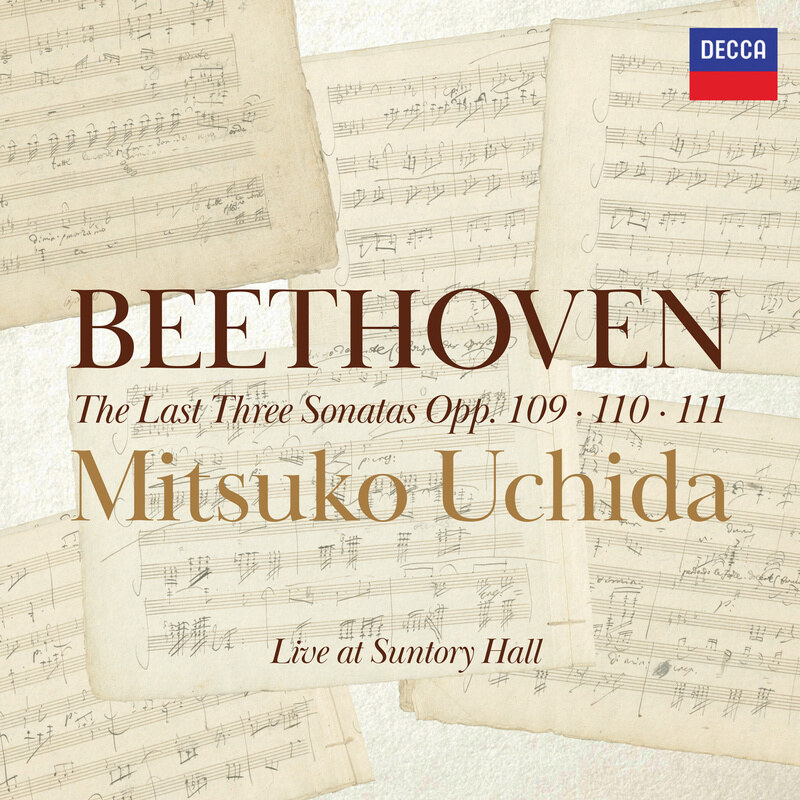
Mitsuko Uchida releases "Beethoven: The Last Three Sonatas Op. 109-110-111"
Decca Classics announces a new recording from legendary pianist Mitsuko Uchida of Beethoven’s final three piano sonatas, Opp. 109, 110 and 111, recorded live at Suntory Hall in Tokyo in October 2025 and released on 24 July. The album marks Uchida’s second and final recording of these works, nearly twenty years after her first acclaimed account in 2006.
Widely regarded as one of the supreme Beethoven interpreters of our time, Uchida returns to music that has remained central to her artistic life and concert career for decades.
The recording follows her award-winning Diabelli Variations, which received the Gramophone Piano Award in 2022 and a Grammy nomination in 2023. Her performances of the sonatas at Carnegie Hall in 2023 were met with widespread critical acclaim, with The New York Times praising “the wisdom and clarity that comes with decades of interpretive rigor and commitment”. More recently, The Guardian described Uchida’s interpretations as “a privileged eavesdropping on a personal communing with the spirit of Beethoven”, adding: “Beethoven’s last three piano sonatas are a gift for a pianist as adept at balancing the playful and the profound as Mitsuko Uchida.”
The idea to revisit the sonatas emerged after touring the works in 2023, leading to these live performances recorded at Suntory Hall in 2025. The venue holds a particularly close association with Uchida, who has considered it her home hall in Japan ever since appearing in its opening season in 1986. As Suntory Hall’s only Associate Artist, these concerts also marked her first recital there since 2021.
Composed between 1820 and 1822 alongside the Missa solemnis, Beethoven’s final sonatas represent the summit of his writing for piano. Radical in structure and emotional scope, the three works push beyond the conventions of sonata form into music of profound introspection, spiritual struggle and transcendence.
As Misha Donat writes in the album booklet notes, Beethoven explores “radically new approaches to the genre, in which the main weight is placed firmly on the finale”. In Opp. 109 and 111, expansive variation movements unfold with increasing serenity and stillness, while Op. 110 culminates in an extraordinary fusion of aria and fugue that journeys from grief towards renewal.
The Sonata in E major, Op. 109, moves between lyricism and intensity before arriving at a final set of variations of luminous calm inspired by the spirit of Bach and Handel. The Sonata in A-flat major, Op. 110, combines tenderness, wit and tragedy, concluding with a monumental fugue that emerges from the exhausted fragments of a mournful arioso. The final sonata, Op. 111, presents Beethoven at his most uncompromising, contrasting a turbulent opening movement with a transcendent concluding Arietta whose variations dissolve into stillness and silence.
Tracklist
- Mitsuko Uchida - Beethoven: Piano Sonata No. 30 in E Major, Op. 109: Vivace, ma non troppo - Adagio espressivo - Tempo I
- Mitsuko Uchida - Beethoven: Piano Sonata No. 30 in E Major, Op. 109: Prestissimo
- Mitsuko Uchida - Beethoven: Piano Sonata No. 30 in E Major, Op. 109: Gesangvoll, mit innigster Empfindung (Andante molto cantabile ed espressivo)
- Mitsuko Uchida - Beethoven: Piano Sonata No. 31 in A-flat Major, Op. 110: Moderato cantabile molto espressivo
- Mitsuko Uchida - Beethoven: Piano Sonata No. 31 in A-flat Major, Op. 110: Allegro molto
- Mitsuko Uchida - Beethoven: Piano Sonata No. 31 in A-flat Major, Op. 110: Adagio ma non troppo
- Mitsuko Uchida - Beethoven: Piano Sonata No. 31 in A-flat Major, Op. 110: Fuga (Allegro ma non troppo)
- Mitsuko Uchida - Beethoven: Piano Sonata No.32 in C minor, Op.111: Maestoso - Allegro con brio ed appassionato
- Mitsuko Uchida - Beethoven: Piano Sonata No.32 in C minor, Op.111: Arietta (Adagio molto semplice cantabile)
Read more
All articles →