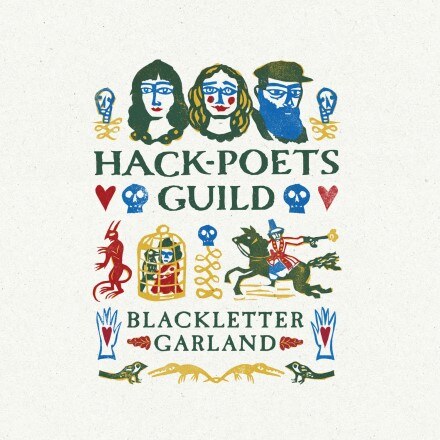
Hack-Poets Guild releases Blackletter Garland
On March 10th One Little Independent are proud to release the high-concept debut album from the brand-new collaboration between three of UK folk’s most unique and prestigious voices; Marry Waterson, Lisa Knapp and Nathaniel Mann. ‘Blackletter Garland’ by Hack-Poets Guild boasts twelve fascinating interpretations and original compositions that tell intricate tales of birth, love, conflict and death, with all the imagination of the folklore from which they’re based.
Inspired by historic broadside ballads, the trio rejuvenate and reinvent these stories, bringing them vividly to life for a new generation. Following an invite to the Bodleian Library by Sound UK Arts, the disposable song sheets (that would’ve once sold for pence, and were the forerunners of modern news media) gave a rare insight into the past whilst striking a chord with themes still relevant today. Celebrated film composer and multi-instrumentalist Gerry Diver helped in their exploration as a producer, and in adding fresh ideas to these past texts.
Across the LP anecdotal, descriptive yarns are spun to a backdrop of atmospheric strings, rustic instrumentation and elegant vocal harmonies used precisely to communicate the victims as easily as they do the villains. The result is a compelling and thoroughly enjoyable balance between the traditional and contemporary.
Drawn to folklore, customs, ghosts, witches and legends, Marry Waterson wrote album opener ‘Ten Tongues’, a gothic windswept beauty, from a story collected by 18th century Oxonian Percy Manning. “Birds build a nest in a rotting skull, deliciously dark but here we see a cycle of rebirth too” she tells us. Fascinated by the origin of idioms ‘Laying The Ghost’ tells of spirits that are “read down” until they are small enough to be trapped in a box and laid in a body of water – Marry’s poetic lyrics and other-worldly voice forewarn as waters run dry and the spectre rises.
Marry adapted the lyrics for ‘Something To Love Me’ and ‘Be Kind To Each Other’ from the Harding Collection in the Bodleian. “This is the language of yesteryear shaped into contemporary melodies of my own”, she says, and the sentiments still resonate today, particularly on ‘Be Kind To Each Other’, with lyrics detailing the loss of loved ones, carry extra poignancy following the events of last couple of years. “No lies, no envy, no slights, don’t let anything get in the way of keeping your loved ones close, because the world can be a very cruel place”.
Singer, songwriter, multi-instrumentalist and BBC Folk Award Winner Lisa Knapp brings her renowned expressive originality to the first single release off the album, ‘Daring Highwayman’, eschewing any allusions to grandeur Lisa delivers a disarming, brazen almost-spoken vocal to animate this pervasive story. “The idea of the highwayman as a sort of Robin Hood character has persisted for centuries, pushing itself out of ballad sheets and right into popular culture which is really intriguing. I thought it would be an interesting place to start and I think the narrative sits perfectly with the audacious glam-rock treatment here incited by producer Gerry and drummer Laurence Hunt.”
In her treatment of 17th century polemic ‘The Troubles of This World’ Lisa’s strident vocal makes a compelling case for the struggle of the poor and working class against the tyranny of the powerful. “When I first saw this set of verses I couldn’t believe how modern they felt. This could have been written last week.” Joined by Marry & Nathan on full harmony and chorus duties together with jarring strings this track beats the drum for an end to inequality with as much poignancy now as at any time in history.
By contrast Knapp’s emotive treatment of ‘Birds of Harmony’, with its utterly unique sound world, tells a bewitching origin myth of the birds of the forest. Conjuring a track full of space for notes of regret, sadness, lost love and found love; the reasons the birds give for their colours and songs Lisa weave’s two historic tunes together seamlessly to create a rare glamour of mystical charm. “These verses really stood out for me as I’ve only ever heard this in fragmentary form on an archive. Mostly birds in song are used as a vehicle for human stories but this ballad presents itself as the birds singing for themselves like a sort of genesis which is really unusual and that appealed to me.”
Nathaniel Mann, a prize-winning experimental composer, performer and sound designer, also describes the true history behind the solemn track ‘The Devil’s Cruelty’, based on the real-life tragedy of George Gibbs who in 1663 was tempted by the Devil to take his own life. “This is an inconsolable tragedy; and George Gibbs could represent anyone. In the song we learn that George has love, work, no debts and good health, and that his neighbours think he is quite happy. Yet the devil returns time and again to tempt him to take his own life. Folk song often references suicide, with star-crossed lovers making pacts, throwing themselves overboard, taking their own lives due to heartbreak. But it’s really unusual to find an account like this, one that can be so easily interpreted as someone severely struggling with their mental health. For me it’s insightful to hear this true story of a Londoner from the past, and to recognise the presence of these issues throughout time. Somehow that fosters a greater connectedness, an understanding, an empathy.”
Elsewhere on the album, ‘Hemp & Flax’ takes its title from hemp beating, sung from the perspective of female inmates at Bridewell prison and is performed with a hemp beating brake and mallet. A drastic swerve away from conventional folk tones comes with ‘Meat For Worms’. Dating back to the 16th C. this ancient existentialist lyric is brought into sharp 21st C. focus with contemporary production to create a distorted, autotuned and pitch-shifted hymn.
As an example of how these narratives have travelled the world, before we’re seen out we’re left with ‘Cruel Mother’. This particular version of the disturbing murder ballad was collected in North Carolina by Cecil Sharp in 1916, from the singing of Ms Rosie Hensley. Using her plucked fiddle and minimal production Knapp’s sensitive and stark vocal steadily conveys this harrowing tale. The constant refrain “all alone and aloney” a salient condition of the protagonist yet its repetition lends a chilling lullaby quality throughout in perfect antithesis to the immense darkness and desperation present all along.
On ‘Blackletter Garland’ the acclaimed trio combine a wealth of knowledge and history, on an album that deeply conveys the passion, research and authenticity that the writers, poets and their stories deserve.
Read more
All articles →