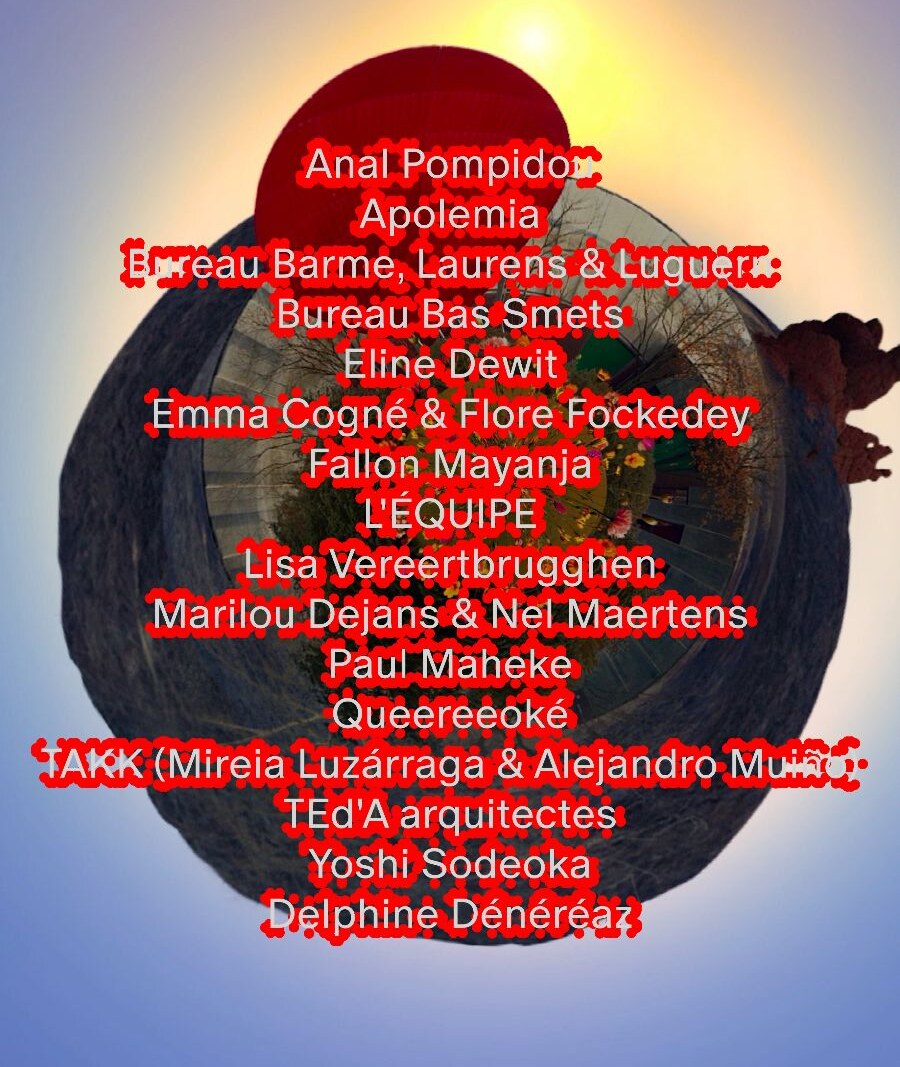
Horst 2026 unveils arts & architecture programme ft Bas Smets, TAKK, L’EQUIPE, TEd’A, Fallon Mayanja, Paul Maheke, Apolemia
Horst Festival unveils its arts and architecture programming for the 2026 edition, returning to Asiat Park, Vilvoorde from May 14-16, 2026. Following the earlier announcement of its music programme, which foregrounds evolution over repetition and places Belgian artists at the core of a forward-looking global club conversation, Horst now reveals the artistic and architectural practices that will shape the site itself. Together, the programmes form an integrated cultural ecosystem rooted in allyship, collaboration, and collective authorship.
Louise Goegebeur, Horst Head of Arts explains further: “Horst Arts 2026 starts from a simple belief: multiplicity isn’t noise, it’s the essential condition of public space. In a time of homogenisation and polarisation, we choose to build places where multitudes are not only tolerated, but actively cared for. From permanent spatial interventions to live moments of gathering, our arts programming treats Asiat Park as a shared infrastructure for encounter, experimentation and collective imagination.”
Art as a shared practice
This edition, Horst deepens its commitment to allyship, collaboration and collective authorship by broadening perspectives and supporting artists from start to finish.
In that spirit, Horst forms new alliances with The Constant Now, a nomadic non-profit that empowers artists of colour, to present a new performance by Fallon Mayanja (production support is kindly provided by S.M.A.K. Moves and Flanders State of the Art). Developed through a week-long, POC-only collective atelier, the work unfolds across the festival weekend as a daily performance, integrating sound, voice, and movement. The piece foregrounds Black and historically marginalised voices, offering audiences an immersive experience of collective authorship and creative collaboration.
French artist Paul Maheke, working in collaboration with curator Evelyn Simons (herself a former Horst arts curator) and currently in residence at Villa Medici in Rome, presents a work that moves through themes of death, transition and embodiment, unfolding between spatial installation and live performance, and marking one of the programme’s central artistic anchors.
Horst also collaborates with Queereeoké, a Germany-based community collective bringing its radically inclusive karaoke format to the festival on Saturday night. Queereeoké creates open formats that encourage participation and joyful self-expression, extending the festival’s focus on empowerment and inclusive space-making.
Finally, Horst further gives space over to new collectives allowing them to programme autonomously. Brussels-based groups Apolemia (currently performers-in-residence during the club season) and Anal Pompidou, who between them will engage nearly twenty artists across the weekend. Probing the line between the acceptable and the necessary, Anal Pompidou will intervene in a previously off-limits building on the Asiat Park site, bringing, in their own words, “D.I.Y. special effects, meets homosexual desires, meets institutional-diarrhea, meets chaotic energy, meets unsubsidised hemorrhoids, meets you, the audience in the intimacy of the moment.”
Architecture as a living organism
Running parallel to the arts programme, Horst’s 2026 architecture commissions continue to explore how built structures can function as social infrastructure. In collaboration with VAi (Flanders Architecture Institute) Belgian landscape architect Bureau Bas Smets brings Building Biospheres, previously showcased at the Belgian pavilion at the Venice Architecture Biennale, to Asiat Park. Together with students from Horteco, the horticultural school in Vilvoorde, the plants are being carefully tended and overwintered ahead of their reinstallation in our celebrated Rain Room in April. Students will also be actively involved in the reassembly of the installation, continuing a meaningful hands-on partnership that connects education with large-scale ecological design.
Across the site, newly commissioned stages expand Horst’s architectural landscape. Spanish studio TAKK (Mireia Luzárraga & Alejandro Muiño) will create a temporary indoor structure and Mallorca-based duo TEd’A arquitectes revisits and reinterprets the iconic Moon Ra stage, which will host sets and performances streaming live through New York’s The Lot Radio and Brussels Kiosk Radio.
Elsewhere across the site, award-winning, female-led practice L’ÉQUIPE architectes designs a temporary entrance installation inspired by the spatial logic of car washes, reframing arrival as a sensory passage from city into festival. Finally, Delphine Dénéréaz whose work uses medieval tapestry techniques to conjure faux-naive interventions on the subject of place and belonging. This site specific work is one of several of this year’s architectural commissions to remain in place after the festival, true to the organization’s continuing work to contribute to Asiat Park’s transition from a vacant military base into a dynamic public space where a mix of people can cross paths.
Music, arts and architecture in dialogue
The arts and architecture programme unfolds alongside Horst’s previously announced 2026 music programme, which brings together over 120 artists across DJ sets, live performances and hybrid formats. Guided by a philosophy of evolution over repetition, the lineup places Belgian artists at its core while welcoming international voices chosen for their depth, intention and long-term cultural resonance.
Highlights include appearances from Todd Edwards, Stacey Hotwaxx Hale, Daphni, Gilles Peterson & MC Rob Galliano, alongside Belgian artists such as AliA, Altinbas, Ben Kamal, Clara D, Nefeli, and Shabz. Across the site, hybrid performances and live collaborations further blur the boundaries between concert, club and performance, reinforcing Horst’s position as a DIY spirited cultural platform.
Read more
All articles →