Mythless (mem. of Fang Island) Announce Debut LP 'Hex', Share "
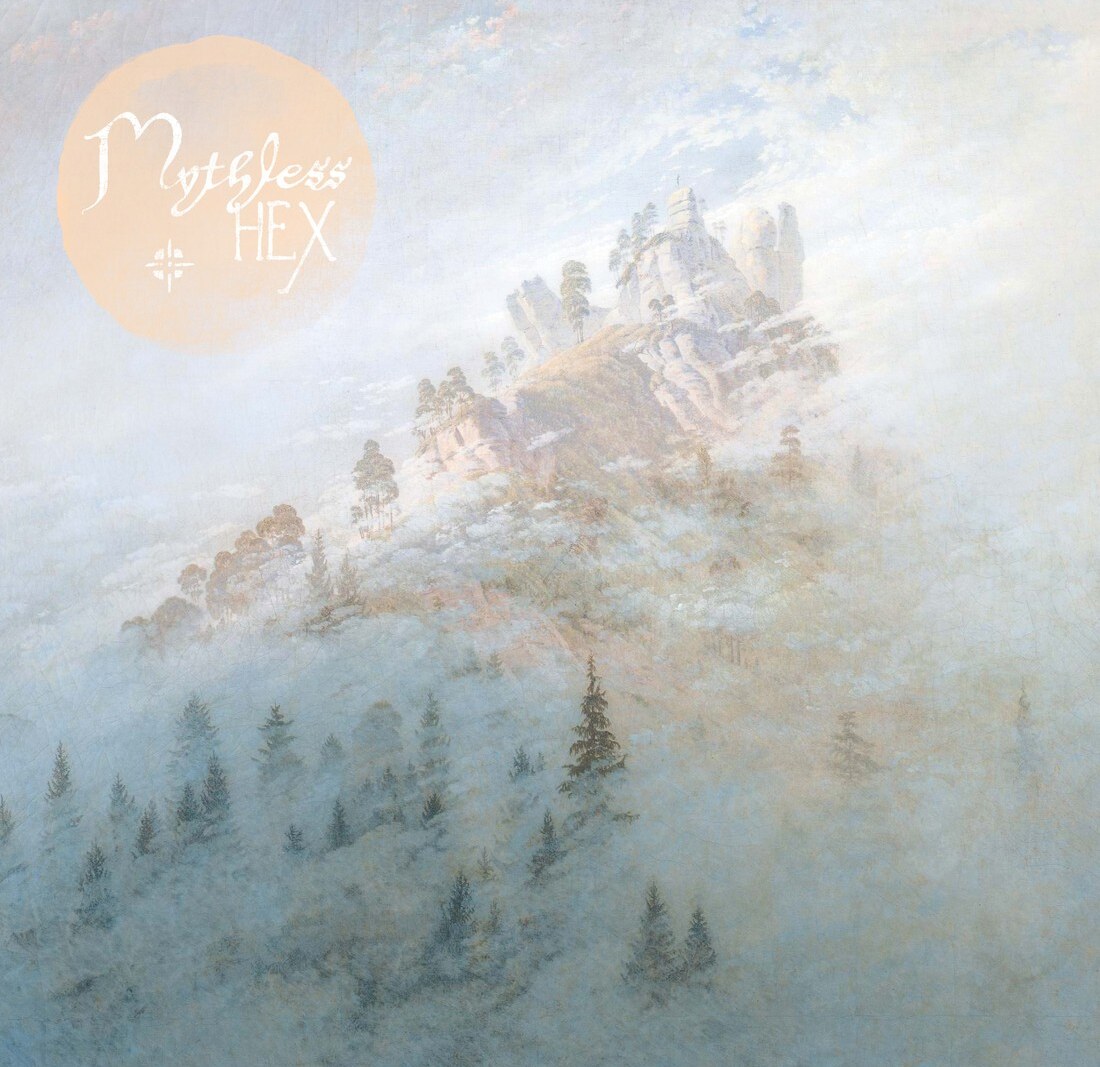
Mythless, the maximalist progressive rock duo led by Fang Island co-founder and guitarist Jason Bartell, announced today their debut LP, Hex, and released the new single "Brocken Spectre."
The announcement follows a long gestation period for the Mythless project, arriving after two EPs and an elaborate box set reissue of the Fang Island discography. Joined by fellow Fang Island member, drummer Marc St. Sauveur, and working again with engineer Seth Manchester (The Body, Lightning Bolt, Battles), Mythless create a tonal feast. With Hex, Bartell has written a love letter to the people, places, and music that set the trajectory of a life in art.
New single "Brocken Spectre" was inspired by the natural phenomenon of the same name—a visual illusion occurring in certain alpine light conditions producing a mysterious rainbow aura around a figure’s shadow, also called “a glory,” which has historically given rise to grandiose myth-making. The song’s haunting call-and-response vocal and distorted, opulent guitars conjure this mirage; a gripping introduction to Mythless’ exalted and meticulous world.
ABOUT HEX:
If you loved Fang Island, you’ll almost certainly love Mythless. Jason Bartell might have been the biggest Fang Island fan of all and the Mythless mastermind’s self-titled debut is, in a way, a tribute to his dearly departed band. Perhaps a couple dozen people will catch all of the lore and namedrops sprinkled throughout Hex, but as much as Bartell captures the specifics of a life spent in art - the formative jam sessions and DIY shows, discovering the boundless talents of your close friends, playing that one album on repeat - these are all love songs, about the people and places and especially the music that set the trajectory of your life. To clarify, if you’ve loved, truly fallen hard for any kind of music, you’ll almost certainly love Mythless.
Ironically, Jason Bartell began Mythless as an exercise in forgetting. Like most men reaching 40, he was getting existential, questioning whether their true self had become obscured by the stories they told themselves: about RISD, the Providence noise scene, the last gasps of Brooklyn blog rock, about the permanence of friendship and marriage. Mythless was a way to “cross-fade” his past and future as Fang Island quietly unwound in 2015, and in the ensuing years, its purpose as a creative outlet evolved alongside Bartell as he took on new roles: he started a Smashing Pumpkins cover band, he immersed himself in New York’s experimental dance scene and wrote six-hour drone pieces, he entered new romantic and creative partnerships and salvaged ones that had fallen to the wayside. Meanwhile, Fang Island’s recorded output was given a lavish reissue in 2024 that served as a “proper tombstone for that era” for Bartell.
In the process, Mythless completely flipped into an act of remembrance, with Bartell accepting his actualized self as an artist: a guy who loves electric guitars. “That’s who I am, that’s what comes out when I sit down and play guitar and that’s not gonna change,” he jokes. “I don't play acoustic guitar. I'm not good enough to play acoustic guitar. It needs to be distorted and loud.” The first word on Hex is “overwhelm,” the last is “euphoria” and in between, Bartell’s messages describe the medium: “crushing sound,” “hellbent on splendor.” “This small part needs to be smaller and the big part needs to be bigger,” he says of the process. “That hit needs to be punishing, but it’s so beautiful.”
Working once again with Seth Manchester (The Body, Lightning Bolt, Battles) at Machines with Magnets studio, Bartell creates a tonal feast Hex: there are electric guitars that sound like live horn sections and ones that sound like the synth brass on a late-90s Ruff Ryders track. There are guitars that sound like the Blue Angels flying in formation and ones that sound like an entire Guitar Center speedrunning through the first disc of Mellon Collie and the Infinite Sadness. There are guitars that sound like switched-on Rhys Chatham, Lightning Bolt playing the Nutcracker Suite and the one time Billy Corgan tried to make a hip-hop beat for Shaq. The presence of Fang Island drummer Marc St. Sauveur provides crucial grounding for Mythlessboth sonically and spiritually; Bartell credits their reunion during the making of Hex as the connector between their cherished past and bold future.
Its exuberant optimism for the possibilities of a 100-year old instrument is at once a charming anachronism and stunningly current, a testament to what Bartell calls “Schrodinger’s guitar” - a state where rock music is somehow always totally dead or totally revived, where AI threatens the very notion of human artistry and the biggest new rock bands sound like they could’ve headlined the Cake Shop and Fort Thunder in 2002, before they respectively became an axe throwing bar and the subject of a Netflix documentary.
While Hex is inspired by the inexorable march of time, it’s not a hopeless nostalgia where everything good has already happened. The past isn’t something meant to be mourned but celebrated as a renewable resource that guides our path forward. “2006” namechecks “We Were Lions,” a key track from Fang Island’s debut Day of the Great Leap, celebrating its 20th anniversary this year. “I’m alive, it’s 2005,” Bartell sings, recalling the two-month period where he circled the periphery of Fang Island before the practice that would set his next two decades in motion. “I just saw it all unfold, it wasn’t just like, ‘oh, this is cool,’” he explains. “This is my life.” On Hex’s showstopping ballad “Three Notes,” Bartell pays tribute to an era of “getting buzzed in the back of a pickup truck/covered in dry mud,” humming along to the riff from “Patterns on the Wall.” Written by fellow Providence noisemaker Joseph Buzzell. “Our friend group was like, ‘this guy is the genius hit maker,’ and then he just stopped making music,” Bartell laments and Fang Island paid tribute with a cover featuring Andrew WK after his passing in 2013.
Bartell is well aware of the sadness and loss that lurks underneath the bold and brilliant exterior of Hex; every song touches on some flashpoint that fundamentally altered his life and there’s only eight of them. “The fact that these aren’t replicable, that’s just aging, right?,” he asks rhetorically. “You can’t have one of those every day, that’s probably what mental illness feels like.” Indeed, “Forever New” asks if the logical endpoint of nostalgia is wishing for death. But in that moment, Hex offers another exuberant riff, another stacked harmony, another lyric that sees the life we’re living now as the reward for everything that came before. And for Bartell, it’s a life of possibilities, as long as electric guitars can make new noise. “People are always like, ‘great art comes out of poetic sadness and struggle. That is not me.”
Read more
All articles →