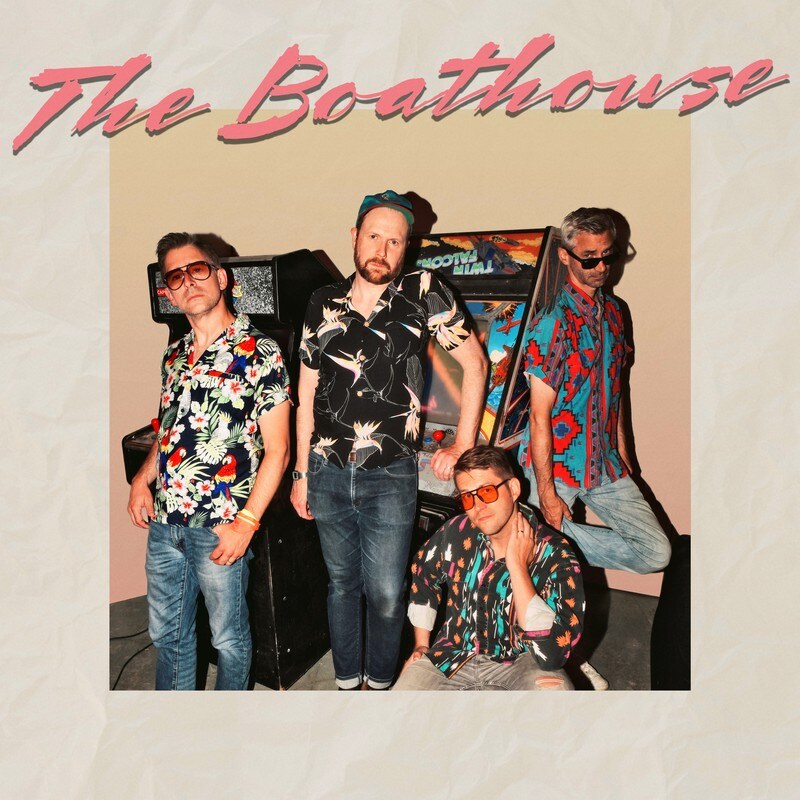
The Boathouse Pair Smooth Yacht Rock With Dark Sci-Fi Storytelling on Self-Titled debut album, Helmed by Shimmery Lead single "Staring Down the Night"
What happens when the smooth, sun-soaked sounds of yacht rock become the soundtrack to a world coming apart? Toronto quartet The Boathouse explore that contradiction on their self-titled debut album, The Boathouse, pairing the glossy harmonies, soaring guitars and shimmering synthesizers of ‘70s and ‘80s album-oriented rock with darkly humorous visions of a technology-driven dystopian future. Arriving alongside the album, focus track “Staring Down the Night” brings that world into focus through a cinematic escape story set against the crumbling glamour of an imagined Los Angeles.
Originally conceived as a handful of singles, The Boathouse grew into a full-length album as the band realized their growing collection of songs shared a common musical and lyrical identity. Drawing from the polished rock sounds of Steely Dan, Hall & Oates and Toto, the quartet embraces the era’s larger-than-life arrangements while taking lyrical inspiration from Warren Zevon’s sardonic observations of modern life.
“We like smooth hi-fi tones, singing about dystopian scenarios in a major key, and having fun,” explains guitarist and vocalist Ryan Farley (Oscar Tango, Maya Killtron).
Listen to The Boathouse feat. “Staring Down the Night” HERE.
With three songwriters contributing to the album, The Boathouse creates a portrait of an increasingly absurd near future, where corporate technology, unchecked consumption and the conveniences of modern life have begun to spiral out of control. Rather than approaching these themes with outright despair, the band filters them through irony, playful storytelling and an almost defiantly upbeat musical palette.
“Staring Down the Night” expands that fictional universe through the lens of low-budget ‘80s action and science-fiction films. Inspired by the neon-lit, dystopian Los Angeles of direct-to-video cinema, the song follows a character preparing to flee a deteriorating city for the desert, caught between the desire to escape and the possibility of starting over.
Combining the glossy textures of ‘80s AOR with a distinctly modern low end, Ryan initially mapped out much of the arrangement before drummer Josh Trager (Sam Roberts Band) recorded his parts against the existing rhythm tracks. Bassist Tristan Armstrong (The Actual Goners) and keyboardist Vincent Spilchuk (Dragonette, Bedouin Soundclash) then replaced the demo parts with their own performances, reshaping the song through the band’s collaborative approach.
The track also features a guitar solo from New York City-based session musician Tristan Clark, whose expressive playing adds another dimension to its cinematic atmosphere. Mixed by Devon Lougheed (Altered By Mom), “Staring Down the Night” balances shimmering guitars and keyboards with deep, powerful drums and bass, preserving the character of classic ‘80s production without sacrificing contemporary weight.
• THE BOATHOUSE + “STARING DOWN THE NIGHT”
On the right side of the wrong line
Staring down the night when it’s high time
That balance between vintage inspiration and modern execution extends throughout The Boathouse, which was recorded through a largely DIY process. With limited access to traditional studio time, the band tracked drums in rehearsal spaces, garages and occasional studios, often performing their initial rhythm parts together before recording additional instruments and vocals in apartments and basements. As the arrangements evolved, many of those original performances were replaced with new ideas that differed from their live versions.
The finished recordings were brought together with the help of mixers including Carlin Nicholson (Zeus) and Devon Lougheed, giving the album the polished, hi-fi character the band envisioned. Despite its layered production, the quartet remains committed to writing music that can ultimately be performed live without backing tracks, relying on the interplay of guitar, bass, drums, keyboards and three vocalists.
For Ryan, the album also represents a shift toward a more collaborative creative process. Where his previous work with power-pop outfit Oscar Tango centred on concise, guitar-driven rock songs, The Boathouse offers a broader sonic palette and a shared approach to songwriting, with each member bringing their own musical personality to the arrangements.
Beneath the gleaming synthesizers and irresistible grooves lies a band united by the simple pleasure of making music together, even when the future they’re imagining looks anything but bright.
Read more
All articles →